Thinking about adding an ADU to your Santa Cruz property? You are not alone. For many homeowners, an accessory dwelling unit can create more flexibility for family, open the door to long-term rental income, or make better use of a lot you already own. The key is understanding what Santa Cruz allows, what your site can support, and which path makes the most practical sense before you spend money on design. Let’s dive in.
What an ADU means in Santa Cruz
In the City of Santa Cruz, ADUs are allowed on residential and mixed-use properties when they are paired with an existing or proposed residential use. In many cases, the process is handled through building permits rather than a discretionary land-use hearing, which can simplify the path compared with other types of development. The city also notes that some properties in the Coastal Zone may still need a Coastal Permit, so location matters early in the process.
Santa Cruz treats ADUs as part of its broader housing strategy. The city frames them as a way to add rental housing and help homeowners supplement mortgage costs, and the state also highlights ADUs and JADUs as an important housing tool. If your property is inside city limits, the best starting point is the City of Santa Cruz ADU page, not the county program, which applies outside the city.
Start with your intended use
Before you think about floor plans, think about purpose. Your intended use often shapes the best ADU type, likely costs, and the questions you need to answer with the city and your design team.
Many Santa Cruz homeowners consider an ADU for:
- Multigenerational living
- Housing for aging parents
- Space for adult children
- A caregiver suite
- Guest accommodations
- A long-term rental
That last point is especially important locally. Santa Cruz states that on single-family properties with ADUs, the property is not eligible for the city’s short-term rental program because the unit is intended for a household member, family, or tenant. In practical terms, ADUs in Santa Cruz are more of a housing and income strategy than a vacation-rental strategy.
Choose the ADU type that fits your lot
Not every property points to the same solution. In Santa Cruz, the most practical ADU is often the one that works with your existing building and site constraints rather than the one that looks best on paper.
Converted space
Converting legal existing space is often one of the easiest ways to create an ADU on a tighter lot. If you already have a garage or other qualifying area that can be adapted, this route may reduce site-planning challenges compared with new construction.
Attached ADU
An attached addition can work well when you want the unit connected to the main home but still separate in function. This option can be efficient on lots where backyard placement is limited or where utility access is easier near the main structure.
Detached ADU
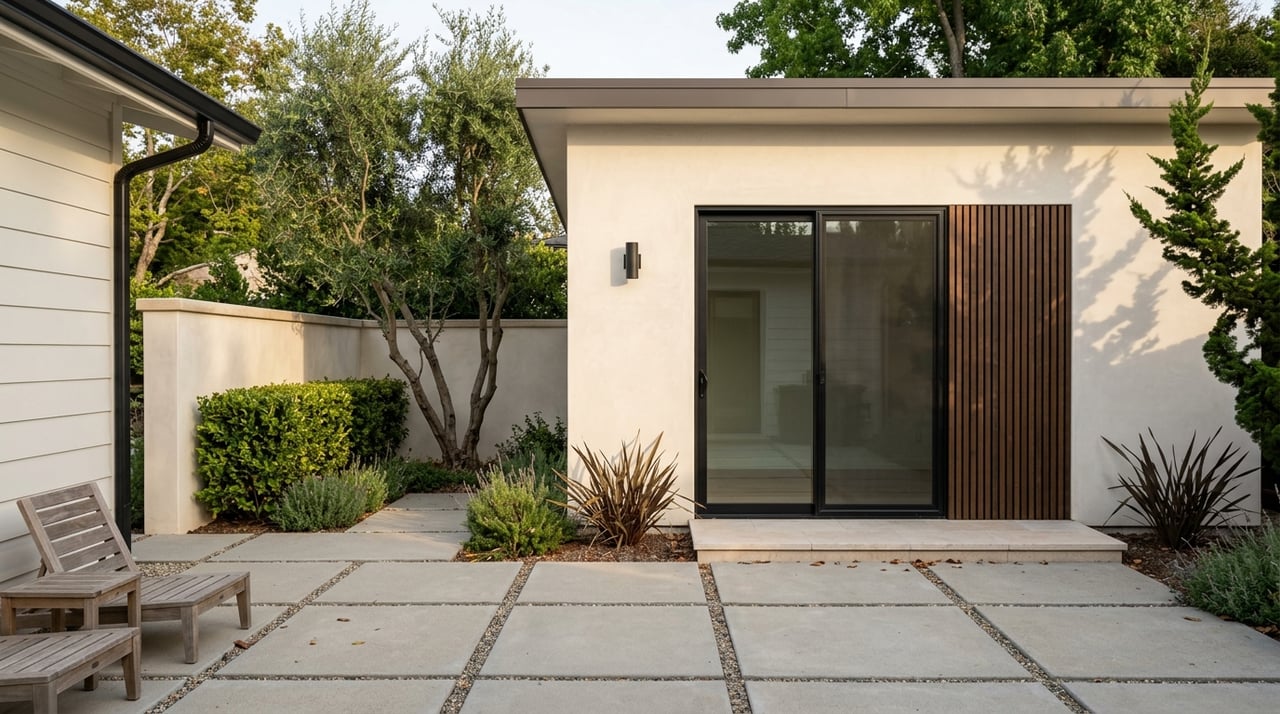
A detached ADU usually offers the most privacy and independence. It is also often the most expensive option, and in Santa Cruz it may trigger new water and sewer connections depending on the design.
Prefab or manufactured ADU
The city notes that a manufactured or prefab unit can help reduce costs, as long as the project still meets zoning and building-code requirements. For some homeowners, that can be a practical middle ground between design flexibility and budget control.
Know the baseline site rules
Santa Cruz provides a relatively clear starting framework for a straightforward detached ADU. According to the city, the streamlined baseline allows up to 800 square feet, with 4-foot side and rear setbacks and a height limit of about 16 feet, with some exceptions near transit corridors.
That baseline is helpful, but it is not the whole story. Real-world feasibility still depends on your property’s layout, utility conditions, and whether your lot sits in a special area such as the Coastal Zone.
Ask the right feasibility questions early
A good ADU project usually starts with site questions, not finishes or fixtures. The city’s planning checklist highlights several issues that can affect design, budget, and timing.
Access and circulation
Ask whether your property has alley access, whether you need driveway access, and how people will reach the unit. These details can affect placement and how comfortably the ADU fits the lot.
Slope and topography
If your lot is sloped, grading and foundation work may become a bigger part of the project. That can influence both cost and the type of ADU that makes the most sense.
Water and sewer capacity
Utility capacity is a major practical issue. The city notes that detached new construction often triggers new water and sewer connections, and fully independent units may be able to have separate utility meters.
Coastal Zone status
If your property is in the Coastal Zone, your parking rules and permitting path may differ from properties outside it. This is one of the first facts to confirm before you move too far into planning.
Parking is often more flexible than owners expect
Parking is one area where many homeowners assume the rules will be stricter than they are. Outside the Coastal Zone, Santa Cruz says no off-street parking is required for an ADU, and parking spaces removed to make room for the unit do not need to be replaced.
Inside the Coastal Zone, parking and replacement rules vary by location. That means two otherwise similar properties can have different planning considerations based simply on where they sit.
Fire and safety can shape the design
Fire and life-safety standards are another reason to evaluate the full property before finalizing plans. Santa Cruz says an attached ADU that is larger than 50% of the existing home’s habitable area may trigger sprinkler requirements for the whole structure.
At the same time, state guidance says ADU construction should not by itself force sprinklers into the existing primary home. Properties in wildfire-prone areas may also face added building standards, so these issues should be reviewed early with the right professionals.
Owner occupancy and rental rules
Current state law has changed the ADU landscape over time. According to CAL FIRE’s 2025 ADU bulletin, AB 976 removed ADU owner-occupancy requirements, among other updates.
In Santa Cruz, ADUs do not require owner occupancy, but JADUs still do. That distinction matters if you are comparing a full accessory dwelling unit with a junior accessory dwelling unit and thinking about future flexibility.
If you have an older unpermitted unit
Some Santa Cruz properties already have older secondary units that were built without full permits. If that sounds familiar, it may be worth looking into the city’s streamlined legalization path rather than assuming the unit must be removed.
The city says a streamlined process is available for ADUs or JADUs built before January 1, 2020 under AB 2533, and notes that many existing unpermitted units can be brought into compliance. That can be a meaningful opportunity for owners who want to improve legal status, financing options, and future marketability.
How ADUs can affect value and market appeal
A permitted ADU can make your property more flexible to use and potentially more attractive to future buyers. Fannie Mae says ADUs can add value, provide extra living space, and support rental income, while Freddie Mac says they may increase long-term property and resale value.
Still, it is important to stay practical. There is no fixed premium for adding an ADU, and the value impact depends on design, permit status, and comparable sales.
A broader California trend supports the idea that ADUs can strengthen market appeal. The Federal Housing Finance Agency’s California analysis found stronger median appraised-value growth for Enterprise-backed single-family properties with ADUs than for similar properties without ADUs from 2013 to 2023, while also noting that the dataset is limited and needs further analysis.
Legality matters for financing and resale
If you are adding an ADU partly for investment or future resale, permit status matters. Freddie Mac notes that rental income from an illegal ADU may not be used to qualify for financing, and appraisal treatment depends on comparable sales and, when needed, comparable rentals.
That makes compliance more than a city paperwork issue. It can affect how lenders, appraisers, and future buyers view the property.
Separate sale may be possible in some cases
Santa Cruz has also created a path for some ADUs to be mapped as condominiums and sold separately. This is not a simple design decision, though. The city notes that lender consent and recording or map approvals are still required.
For the right owner, this may create additional long-term flexibility. It is best understood as a legal and transactional path that needs careful evaluation, not as an automatic feature of building an ADU.
A practical way to think about your next step
If you are in the early stages, focus on a short list of decision points first:
- Whether your property is inside Santa Cruz city limits
- Whether the lot is in the Coastal Zone
- Whether conversion, attached, or detached construction fits best
- Whether your goal is family housing, long-term rental income, or both
- Whether water, sewer, access, slope, or fire rules could affect cost
- Whether any older unpermitted space should be evaluated for legalization
When you approach the project in that order, you can usually avoid a lot of wasted time and redesign.
An ADU can be a smart way to create housing flexibility and improve how your property works for you, but the best outcomes usually come from matching the unit type to the lot, the rules, and your long-term goals. If you want help thinking through marketability, property strategy, or how an ADU may fit into your broader ownership plans in Santa Cruz, connect with Breakwater Properties.
FAQs
What are the basic ADU size and setback rules in Santa Cruz?
- For a straightforward detached ADU in Santa Cruz, the city’s streamlined baseline is up to 800 square feet with 4-foot side and rear setbacks and a height limit of about 16 feet, with some exceptions near transit corridors.
Do Santa Cruz ADUs require owner occupancy?
- No. Santa Cruz says ADUs do not require owner occupancy, but JADUs still do.
Can you use an ADU in Santa Cruz as a short-term rental?
- On single-family properties with ADUs, Santa Cruz says the property is not eligible for the city’s short-term rental program because the unit is intended for a household member, family, or tenant.
Do you need parking for an ADU in Santa Cruz?
- Outside the Coastal Zone, Santa Cruz says no off-street parking is required for an ADU, and removed parking does not need to be replaced. Rules can vary inside the Coastal Zone.
Can an unpermitted ADU be legalized in Santa Cruz?
- In some cases, yes. Santa Cruz says a streamlined process is available for ADUs or JADUs built before January 1, 2020 under AB 2533, and many existing unpermitted units may be brought into compliance.
Does adding an ADU increase property value in Santa Cruz?
- A permitted ADU may improve flexibility, rental potential, and buyer appeal, but there is no guaranteed value increase. Actual impact depends on legality, design, and local comparable sales.