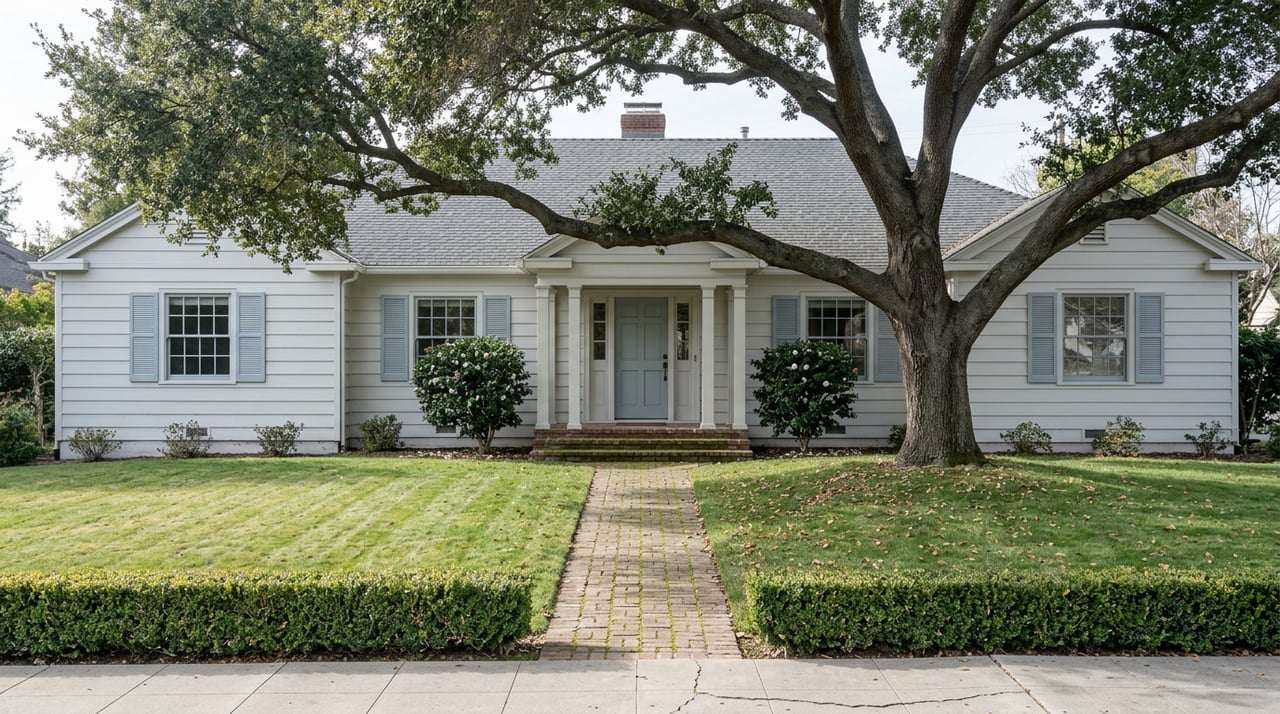
Most Burlingame homeowners who call a contractor about an addition or an ADU think the tree in the backyard is a design detail. In reality, that tree might be the single item that determines your timeline, your footprint, and a five-figure line in your budget. The city rewrote its tree ordinance at the end of 2024, adding real financial teeth where there used to be almost none, and the trees themselves have spent the last fifty years quietly growing into a rule that didn't used to apply to them.
Put those two facts together and you get the thing this post is actually about: a homeowner who did nothing differently than their neighbor did a decade ago can still end up with a much bigger problem, simply because the calendar moved and the trunk got wider.
A Threshold the Tree Grew Into, Not One You Crossed
Burlingame's tree protection isn't limited to a short list of named specimens. Under the county definitions that apply to unincorporated Burlingame Hills, a "significant" tree is any trunk of roughly 12 inches in diameter, measured at four and a half feet above the ground. Several native species qualify as Heritage trees at diameters as low as the mid-teens.
That threshold means a tree planted during the Peninsula's postwar building boom, or even one planted in the 1970s as a modest sapling, has had four or five decades to grow into full legal protection. Nobody applied for that status. Nobody filed paperwork. The tree simply got wide enough.
A tree nobody planted last year can still turn this year's permit into next year's problem.
For a homeowner who bought a house with mature trees already on the lot, that's the entire risk in one sentence. The ordinance isn't reaching further than it used to. The trees are.
What Changed in December 2024
For nearly fifty years, Burlingame's tree code sat under Ordinance 1057, adopted in 1975. On December 16, 2024, the city council repealed and replaced that chapter with Ordinance 2037, and the practical difference matters more than the date suggests.
The old code had permitting fees for a legitimate removal, but it had essentially no penalty structure for skipping the process. The revised chapter changes that. Removing or significantly altering a protected tree without a permit now triggers an After-the-Fact Tree Removal Permit that can run up to ten times the normal permit fee, on top of new violation penalties that didn't exist before. Pruning is capped too: no more than 25 percent of a tree's live tissue can be removed in any 36-month period without director approval, which rules out the old workaround of "heavy trimming" a tree down to a stump over two visits from the crew.
Here's the quick version of what actually applies, gathered from the current municipal code and city notices:
| Requirement | Detail |
|---|---|
| Protection threshold | Roughly 12 inches trunk diameter (county); several native species protected as Heritage trees |
| Pruning cap | No more than 25% of live tissue in any 36-month period without Director approval |
| Unpermitted removal penalty | After-the-Fact Permit fee up to 10x the standard permit fee, plus new violation penalties |
| Neighbor notification | Property owners within 300 feet of a permitted removal receive written notice |
| Appeal window | Filed with the Parks Division under BMC Section 11.06.080 |
The notification radius is worth sitting with. A 300-foot notice zone means your neighbor's tree decisions are now visible to you, and yours are visible to them. Enforcement isn't only a city inspector driving by. It's the person two doors down who gets a letter in the mail and knows exactly what a permitted removal is supposed to look like.
Two Governments, One Neighborhood
Here's the wrinkle that catches people who've lived in town for years: "Burlingame" isn't governed by a single tree ordinance. Most of the city falls under Burlingame Municipal Code Chapter 11.06, the Urban Reforestation and Tree Protection ordinance just described. But Burlingame Hills is unincorporated San Mateo County land. If your parcel sits there, your permitting authority is the county, not the city, and the county's own Significant and Heritage tree definitions apply instead.
The practical effect is that two neighbors who both say they live in "Burlingame Hills" can be operating under different rulebooks depending on exactly where the parcel line falls. Before you assume the city's fee schedule or the city's 25 percent pruning cap applies to your lot, it's worth confirming which jurisdiction actually issues your permit. This is precisely the kind of detail that separates a smooth application from a stalled one.
Where This Lands Hardest: ADUs and Additions
State law made detached ADUs ministerial in most California cities, which is supposed to mean a fast, largely automatic approval. Burlingame still layers its own review on top through Heritage Tree Permits and, for hillside parcels, additional design review tied to slope and height-envelope rules.
The trigger point contractors describe consistently: if a protected tree sits on or within 50 feet of the proposed building footprint, the Heritage Tree Permit has to clear before any ground-disturbing work can start. On many older Burlingame lots, especially in neighborhoods like Easton Addition and Burlingame Park where century-old Craftsman and Tudor homes share space with equally old oaks and eucalyptus, a 50-foot radius from a reasonable ADU location can be difficult to avoid entirely.
Additions and exterior work in those same historic neighborhoods, plus the designated Hillside Area, often trigger Design Review on top of the tree permit, adding an estimated two to three months to the timeline and several thousand dollars in additional design and review fees, according to local permit consultants who work these applications regularly.
Add up the pieces and here's what a homeowner is actually budgeting for once a protected tree is in play:
- ISA Certified Arborist assessment for the permit application: roughly $300 to $900
- Removal cost if approved, by size: small trees run $1,500 to $3,500; large trees $6,000 to $12,000; heritage-protected specimens commonly $10,000 to $18,000 or more
- Stump grinding: $250 to $500
- In-lieu fee if a required replacement tree can't be planted on site: reported at $22,262 under current fee schedules
- Timeline: extra weeks for a straightforward permit, extra months if Design Review is also triggered
None of that is exotic. It's the ordinary cost of building around a legal obligation. The problem is how rarely it shows up in a first-pass renovation budget, because the person doing the budgeting assumed the backyard oak was landscaping, not a permitting condition.
The Grove on El Camino Real Shows the City Means It
If you want evidence that Burlingame takes this seriously even when it's inconvenient, look at the eucalyptus rows lining El Camino Real. Landscape architect John McLaren planted the bulk of them starting around 1875, and the grove was listed on the National Register of Historic Places in 2012. Even those trees aren't immune from removal: a city and Caltrans renewal project along that same corridor has targeted storm-damaged and root-compromised eucalyptus for removal while committing to replant two to three times as many, a project the city projected in 2024 would reach completion by 2026.
That's a city willing to take down a small share of a National Register grove only on the condition that it replants at a multiple, not a city that clears space and moves on. A homeowner weighing whether to skip the permit process on a single backyard oak is operating in the same civic environment. The community's tolerance for unpermitted removal is low, and the 2024 ordinance rewrite gave that sentiment an actual fee schedule.
What This Changes About How You Budget
If you're planning an ADU, a second story, or any addition on a Burlingame lot with mature trees, the sequence that avoids surprises runs in a specific order. Get the arborist assessment before you finalize a design, not after. Confirm which jurisdiction, city or county, actually governs your parcel. Ask your designer to site the structure with the 50-foot dripline rule in mind from the first sketch, rather than treating it as a problem to solve once plans are already drawn.
For sellers, the same facts cut the other way. A tree removed without a permit sometime in the past doesn't disappear from the picture. Buyers doing diligence on a property with recent, unexplained tree loss, or a stump where a mature specimen clearly stood, may ask about it, and an honest answer is the only safe one.
Either direction, this is the kind of local, ordinance-level detail that separates a smooth transaction from a stalled one, and it's exactly the sort of land-use question our team fields regularly from owners planning a build or weighing a sale.
Frequently Asked Questions
Does the ordinance apply if the tree is dead or clearly hazardous? Burlingame's code includes an emergency provision. If a tree poses an immediate danger to life or property, or is diseased to the point of failure, the Director can approve removal without the full permit process. Documentation from a certified arborist still matters if the removal is ever questioned.
Do I need a permit just to trim a protected tree, not remove it? Yes, once the pruning exceeds 25 percent of the tree's live tissue within a 36-month window. Routine light trimming generally doesn't trigger the requirement, but a significant canopy reduction does.
My lot is in Burlingame Hills. Does the city ordinance even apply to me? Possibly not. Burlingame Hills is unincorporated San Mateo County land, and county tree definitions and permitting apply there instead of the city's Chapter 11.06. Confirming jurisdiction before you plan a project saves a redesign later.
If you're weighing a remodel, an ADU, or a sale on a Burlingame property with mature trees on the lot, Breakwater Properties can walk through what the ordinance means for your specific parcel and timeline. Request a Home Valuation and we'll factor the land-use realities into the conversation from the start.