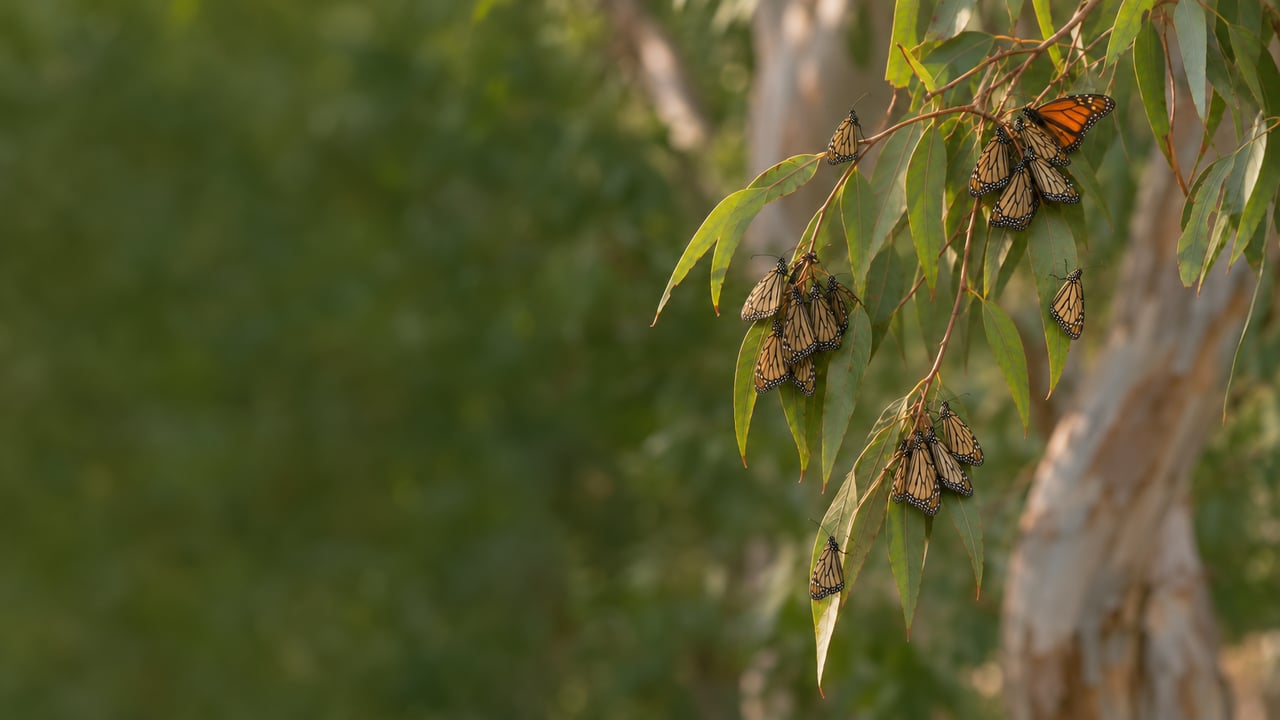
From now through mid-December, the wildlife calendar around Santa Cruz runs four seasons at once. Humpback whales are still turning up on boat trips. A gray whale has already been logged in the bay. The monarch colony at Natural Bridges is heading into its usual peak, and up the coast the elephant seals at Año Nuevo are about to change seasons. By January most of these have passed or settled into a single pattern. In the weeks between now and the holidays they all overlap, within a short drive or bike ride of downtown.
This is a resident's calendar for that overlap: what is out there, when each window opens or closes, and what it costs to go.
The Bay Still Has Humpbacks, and a Gray Has Shown Up
Recent boat logs show that the humpback season has not ended. On November 8, 2026, the Captain's Log at Sanctuary Cruises recorded two humpbacks, one of them "kelping" in floating kelp, along with roughly 300 long-beaked common dolphins. Sanctuary sails from Moss Landing, and its log covers the same bay a Santa Cruz boat works.
Across the bay in Monterey, the October 2026 trip log from Monterey Bay Whale Watch recorded humpbacks on every trip listed for the month, in counts ranging from 2 to 50. The same log has orcas on October 12 and October 23, and a single gray whale on October 24. That October gray turned up more than a month before the December window when grays usually start passing, so the two whale seasons were already sharing the bay in October.
If you want to go out before the month ends, Sanctuary's booking calendar shows departures at 8 a.m. and 11:30 a.m. on its standard boat, plus a 10 a.m. trip on a rigid-hull inflatable, running through late November. Standard cruises start at $68.90 and the inflatable trips at $159.
In December, the Harbor Trips Switch to Gray Whales
Closer to home, the changeover shows up on the schedule at Santa Cruz Harbor. Santa Cruz Whale Watching, run by Stagnaro Charters, runs whale trips all year at $73 for adults, $55 for children ages 4 to 13 and $2 for infants. Every fare includes a $2-per-passenger Port District fee. From May through November the trips focus mostly on humpbacks feeding in the bay. From December through April the focus moves to the California gray whale migration. The operator says the migration usually peaks in mid-January and again in mid-March, with a better chance of seeing orcas from March through May.
Visit Santa Cruz County gives the southbound gray whale window off the county coast as December through mid-February. NOAA Fisheries runs its own shore count at Granite Canyon over the same months, December through February.
The whales coming south this winter belong to a population that has had a hard decade. In a July 15, 2026 update, NOAA's Southwest Fisheries Science Center put the Eastern North Pacific gray whale population at about 17,750 for the 2025–26 southbound season, up from about 12,890 the season before. NOAA called the increase welcome news, and it is also reviewing whether changes in migration timing and survey assumptions account for part of it. The population peaked at about 27,000 around 2016. NOAA's latest calf production estimate, 85 calves in 2025, is the lowest in its records. The agency also reported that strandings over the past two years have climbed back into the range seen during the 2019–2023 unusual mortality event, and that several whales stranded in spring 2026 were thin or emaciated.
That history is part of why a gray whale passing West Cliff in January is worth a look. The count is higher than it was a year ago, from a population that is still producing few calves.
Natural Bridges Usually Peaks Just as the Count Begins
Last winter, Natural Bridges State Beach had the highest monarch count of any site in the Western Monarch Count. According to the Xerces Society's January 29, 2026 release, volunteers counted 2,500 monarchs there in early December 2025. Across 249 sites during the late-November to early-December 2025 peak, the total came to about 12,260 monarchs, the third-lowest tally since the count began in 1997. Western monarchs regularly numbered in the low millions in the 1980s. In a low year, the Natural Bridges grove had the highest count of any site surveyed.
This season's butterflies arrived on schedule. Lily Aravanis, a field interpreter at Natural Bridges, told City on a Hill Press in October that monarchs come in mid-to-late October and that "later in the season … we'll have hundreds, hopefully thousands of butterflies that cluster in the trees." The same article explains why they come back to this spot. Three rings of eucalyptus block the wind, while their open centers let in sun to warm wings. The eucalyptus also blooms in winter, according to Xerces conservation biologist Isis Howard, which puts nectar on the branches when monarchs need it most.
For this season, Visit Santa Cruz County puts the peak in late November and early December, with butterflies leaving by mid-to-late January and sometimes into February. The official mid-season window of the Western Monarch Count runs November 14 through December 6, 2026, which covers Thanksgiving weekend. A late-season count follows from December 26, 2026 through January 10, 2027. The weeks when clusters are usually heaviest are the same weeks volunteers are out counting them.
The logistics are simple. California State Parks lists Natural Bridges as open from 8 a.m. to sunset, with the visitor center open 11 a.m. to 4 p.m. daily from October 1 through January 31. A wheelchair- and stroller-accessible boardwalk leads from the visitor center area to an observation deck in the grove. The self-guided grove walk is open during park hours, and parking is $10. The same park is a State Parks–listed spot for shorebirds, seals, sea otters and migrating whales, and it has freshwater wetland and salt marsh along Moore Creek. One visit can cover the grove and the water.
Año Nuevo Has a Two-Week Gap in December
The elephant seals up Highway 1 run on the tightest dates of anything on this list. According to Año Nuevo State Park, the fall haul-out, when juvenile seals rest on the beaches, runs through November 30. The wildlife viewing area then closes from December 1 through December 14. Breeding season viewing begins December 15 and runs through March 31, 2027, by guided walk only. Tickets for those walks went on sale October 20, 2026.
For someone reading this on publish day, the last days of the fall haul-out are still open. After that, the next chance to see the seals is a guided breeding-season walk starting December 15. Holiday-week walks are the dates to book early if you have family coming.
From Shore, or Indoors on a Rough Day
The gray whale migration can be watched from shore. West Cliff Drive has a 2.5-mile wheelchair-accessible multi-use path, and the City lists public parking and restrooms at Natural Bridges and Lighthouse Field State Beach. Visit Santa Cruz County describes West Cliff as a bluff-top route with benches where whales and dolphins can be seen swimming parallel to shore. Lighthouse Point, home to the Santa Cruz Surfing Museum, is the overlook along that stretch. Our fall routes guide for Santa Cruz covers where the West Cliff path stood this season.
High surf can close things briefly. The City closed city beaches and the Wharf from the night of November 13 through the early morning of November 15 during a surf advisory. On a day like that, UC Santa Cruz's Seymour Marine Discovery Center is the indoor option. It is open Tuesday through Sunday, 10 a.m. to 4 p.m. Admission is $12 for adults, $11 for seniors 65 and over, and $9 for children ages 3 to 17 and students with ID. Children under 3, UCSC students and members get in without a ticket. Docent tours are included with admission at 11 a.m., 1 p.m., 2 p.m. and 3 p.m., first come, first served. Free 90-minute Younger Lagoon tours run at 10:30 a.m. on select Thursdays and Saturdays, and reservations are recommended.
Over the next four weeks, the dates fall in order. Año Nuevo's fall haul-out runs through November 30. Natural Bridges usually peaks between Thanksgiving and early December. The Stagnaro boats switch to gray whales in December, and Año Nuevo's guided walks start December 15.
If living near Natural Bridges and West Cliff is part of why your Santa Cruz home matters to you, Breakwater Properties can give you a clear, local read on what it is worth this winter. Request a home valuation to start that conversation.